.svg)
Jaime and I spent two days at InnoTrans in Berlin last week. It was the biggest edition so far, with more than 3,100 exhibitors and 180 world premieres, and the attendance matched the scale: chairmen and CEOs of the main manufacturers and operators, transport ministers, government delegations and many of the people who make the big decisions in rail.
The general impression is that a lot of what has been talked about for years is now in real products. AI and robotics were everywhere, but mostly applied to specific jobs such as maintenance, inspection and operations, rather than shown as a future vision. Interiors also had a big presence, with close to 300 exhibitors in around 15,000 square metres.
Interiors that change with the timetable
The topic that came up most in our meetings was flexibility. A train does very different jobs across the day and the week: commuters in the morning, a quiet midday, families with bikes and luggage at weekends, night services in some markets. Most interiors are still designed for one of those situations, usually the peak, and the rest of the time the space works less well than it could.
Several operators told us they want layouts that can actually be reconfigured, with seats that fold or move and areas that can switch between seating, luggage and bikes depending on the service. We think this will become a standard requirement in new fleets and in refurbishments, and it is something we are already looking at in our own work.
Night trains are the clearest example. Luna Rail showed its Hotel Pod and Seat Pod in a real passenger vehicle for the first time; the Seat Pod is a workspace during the day and turns into a bed with a button. Tricon presented ALISA, a modular double-deck concept aimed at the capacity and cost issues that have always made sleeper services hard to run. Nox Mobility showed a prototype with private compartments for one or two people. Some of this is still at concept stage, but the direction is consistent: one vehicle that can serve different uses and different price points.
Maintenance as a design input
Some of the most useful things we saw were small. Clerprem had a wall-mounted seat that leaves the floor clear for cleaning. Binder showed fasteners that let carpets be fitted without tools. An operator client of ours told us something similar from the operator side: lifecycle cost is influencing design decisions much earlier than it used to.
This connects with flexibility. If an interior is built from modular parts that are easy to replace, it is also easier to adapt when the service changes, and a fleet that will be in operation for thirty years will certainly see its service change.
Onboard service
Bucher Group presented Panarooma, a restaurant car developed with zweigrad Design and partners including Siemens Mobility. It combines automated logistics, personalisation and flexible lounge areas, with food reaching passengers through integrated routes and robotic systems. What interested us most was that the whole service had been redesigned together, including how it would be operated, instead of adding technology to the existing restaurant car.
Starting from the passenger's journey
Alstom and Decathlon presented a joint design and R&D programme based on field research into how people cycle or use a scooter to get to the station and then take the train. It covers equipment, the station, booking and the space on board. We liked it because it started from observing real behaviour, which is how we approach this kind of work, and because it looks at the whole journey rather than only the vehicle.
Other things worth noting
Alstom showed a frameless bogie, the first of its kind, which reduces weight and vibration and leaves more room for capacity and accessibility. With DB and S-Bahn München it also drove a train in Hennigsdorf remotely from its stand.
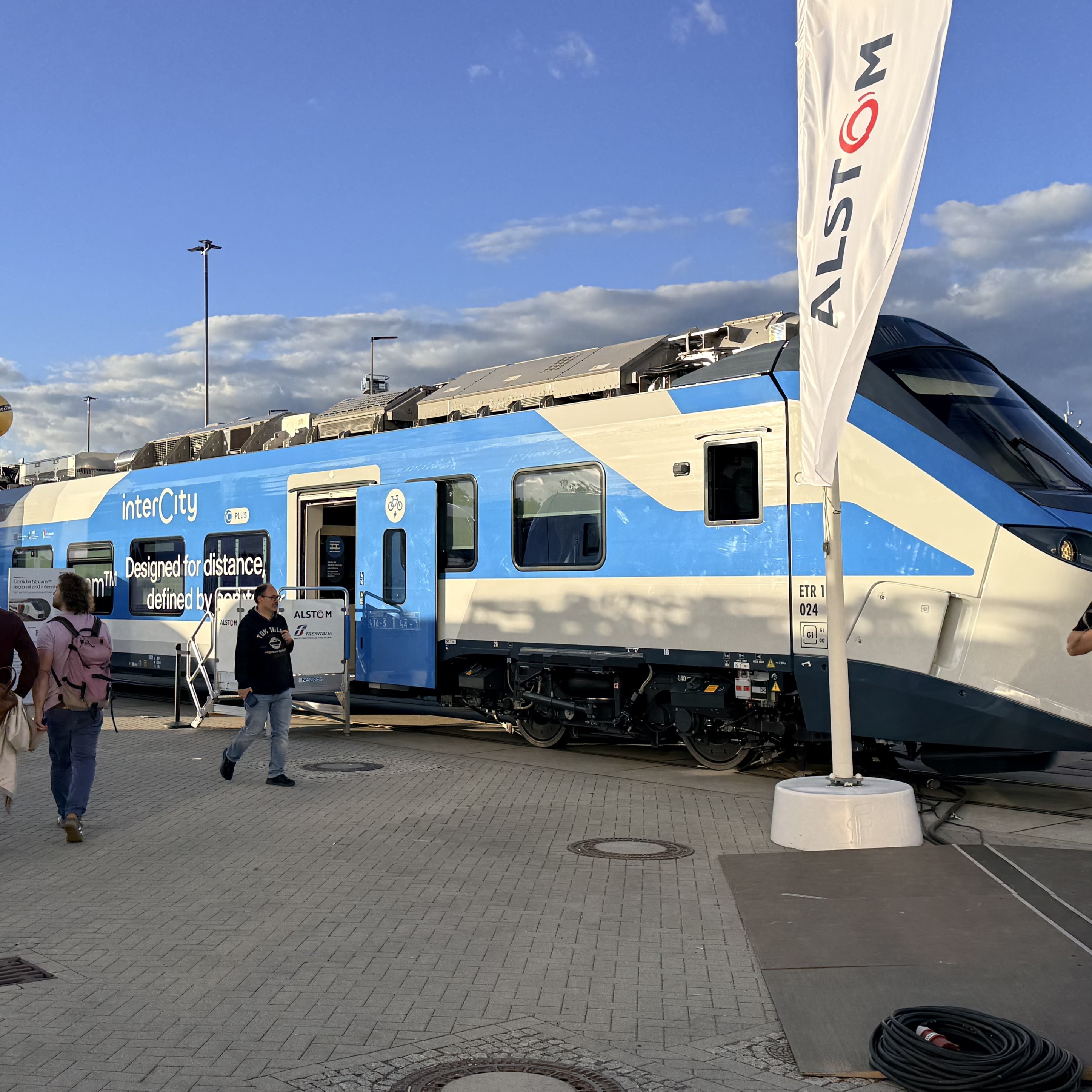
Siemens' new Piccadilly line train for TfL has a bionic aluminium car body that uses less material, an interior laid out to give passengers more space, and air conditioning, which is a first on a deep-tube train. Trenitalia's new Intercity 200 is up to 94% recyclable and uses up to 30% less energy than earlier models.
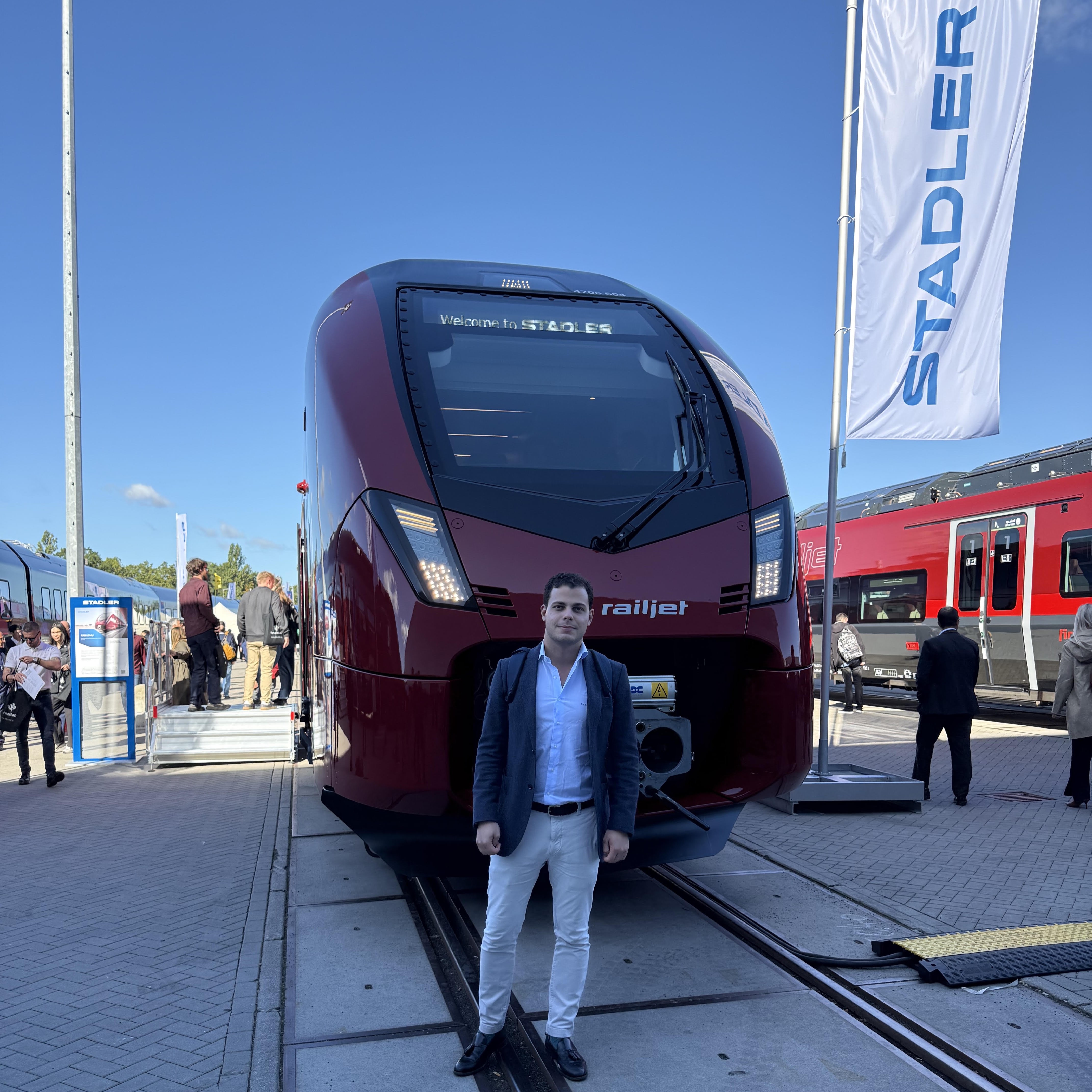
ÖBB was very present, with the world premiere of Siemens' Railjet M for Alpine long-distance routes and Stadler's KISS Railjet and FLIRT Akku. CRRC presented three full-size vehicles for international markets on the first day: a metro, a hydrogen hybrid locomotive and a flat wagon.
Our reading
What we saw in Berlin is an industry where interiors, operations, maintenance and digital services can no longer be designed separately. Decisions about a seat affect cleaning times; decisions about layout affect how many services a fleet can cover. Having so many decision-makers in the same place made it easy to see that these questions are already on the agenda at the top of the industry, not only in engineering departments. That is where we think design can contribute most in the coming years, and it is the kind of problem we enjoy working on with operators and manufacturers.

Vamos a crecer ¡juntos!
¿Tiene preguntas sobre su próximo gran paso?
Mormedi tiene respuestas.