.svg)
From AI and the reinvention of retail to human-centered design, cultural relevance and new business models, Mormedi explores the ideas shaping the next generation of innovation.
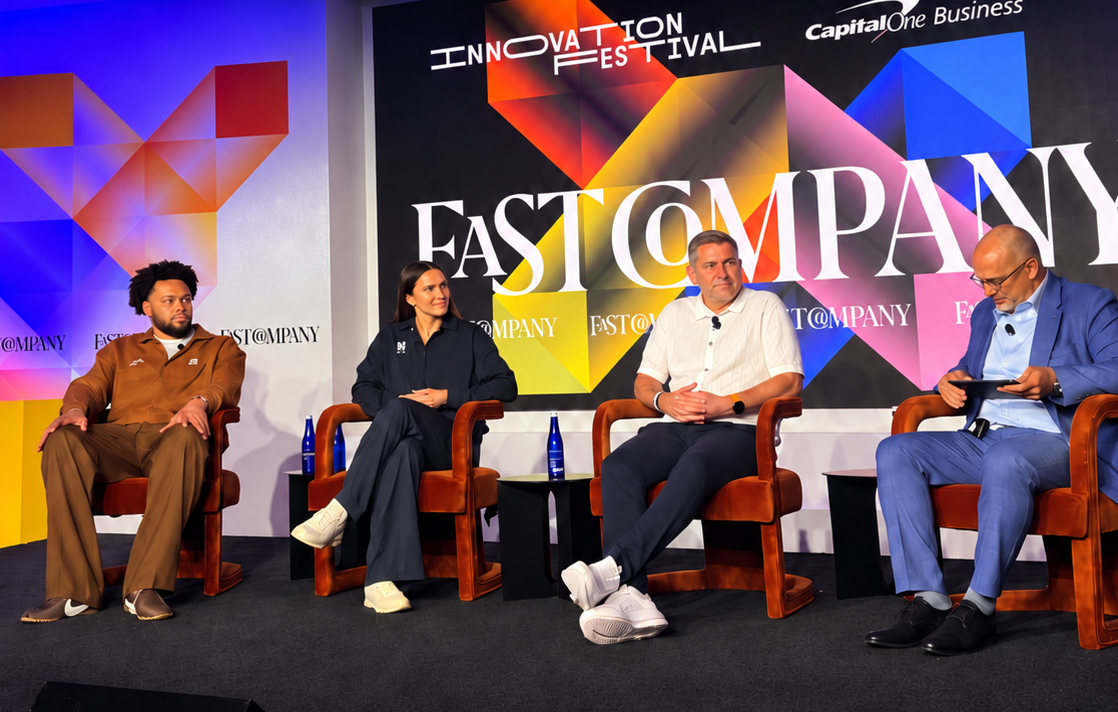
New York once again became a meeting point for some of the world's most influential business leaders, entrepreneurs, designers and creative thinkers as the 12th edition of the Fast Company Innovation Festival took place from September 14 to 17.
Hosted at Convene Brookfield Place, the festival brought together leaders from companies including Nike, Walmart, Adidas, Microsoft, Core Weave and Rare Beauty, alongside entrepreneurs and cultural figures such as Martha Stewart, Tyra Banks, Russell Wilson and Selena Gomez.
For Mormedi, returning to the festival is an opportunity to look beyond individual technologies and examine the broader transformations affecting businesses and the people they serve.
This year's programme highlights a fundamental shift in the innovation conversation.
Artificial intelligence remains a central topic, but the questions have become considerably more specific. How do organizations implement it effectively? How can businesses integrate physical and digital experiences? What makes brands culturally relevant? And how can companies innovate without losing the human qualities that make their products and services meaningful?
Across the festival, several interconnected themes offer valuable insights into how businesses can approach these challenges.
1. Artificial intelligence: From technological capability to meaningful value
One of the defining themes of the 2026 edition is the transition from discussing what AI can do to understanding how it can create tangible value.
A particularly interesting example came from Martha Stewart, who presented Hint alongside cofounder and CEO Yih-Han Ma and investor Brian Kelly, founder of The Points Guy. Their ambition is to simplify homeownership through an AI-powered application that consolidates information about a property, organizes maintenance requirements and helps owners make more informed decisions.
Rather than presenting AI as an abstract technological breakthrough, the discussion illustrated its potential to address a fragmented, often frustrating experience that millions of homeowners encounter.
The platform brings together information that is typically dispersed across manuals, documents, emails and individual service providers.
For Mormedi, the significance lies in the approach: identifying a complex human problem and redesigning the experience around it, with technology acting as an enabler.
Another perspective emerged from the festival's discussions on AI infrastructure.
Mike Intrator, CEO of CoreWeave, features in the closing-day programme to examine why AI requires a cloud infrastructure designed around very different computational demands from those of the internet era.
The session explores the physical and technological foundations required to scale AI and convert its potential into practical applications.
Together, these examples illustrate two complementary dimensions of innovation: developing the infrastructure that makes technological progress possible and translating those capabilities into products and services that people genuinely need.
Mormedi's perspective: The opportunity is not simply to add AI to existing products and processes. It is to reconsider the entire experience, identify where technology can remove friction and determine where human expertise remains essential.
2. Design is becoming an increasingly strategic business capability
Design played a significant role throughout the festival, with discussions moving well beyond aesthetics and traditional product development.
In The New Rules of Great Design, Carson Caprara, Chief Product Officer at Brooks Running; Brooke Ellis, Chief Design Officer at Block; and Emily Galloway, Senior Director of Product Design at Spotify, explored how the fundamental principles of design are evolving as AI accelerates creative processes.
The session addressed a critical challenge: when organizations can generate and develop ideas faster than ever, how do they determine which ideas deserve to exist?
Understanding consumer needs, exercising judgment and making deliberate choices about what not to build remain central to the design process.
Nike offered a complementary perspective.
During Inside Nike's Innovation Reset, Phil McCartney, Chief Innovation, Design and Product Officer, joined basketball stars Sabrina Ionescu and Cade Cunningham to explore how the company is rebuilding its innovation capabilities.
The discussion focused on athlete-driven innovation, including the application of neuroscience, robotics and new approaches to performance footwear.
Central to Nike's approach is the role of athletes as active collaborators in the innovation process, rather than simply endorsers of finished products.
This distinction is particularly relevant to Mormedi's approach to product and service innovation.
Technical capabilities alone cannot determine what makes a product successful.
Understanding people's behaviors, motivations, constraints and aspirations helps organizations identify opportunities that technology-led development might overlook.
The implication extends beyond sportswear.
Whether designing financial services, mobility systems, healthcare experiences or physical products, innovation benefits from connecting user insights, technological feasibility and business viability from the outset.
The role of design is increasingly to bring these dimensions together, helping organizations decide not only how to develop a solution, but which problems are worth solving.
3. Retail is being reinvented as an interconnected ecosystem
The evolution of retail was another prominent theme, with Walmart providing one of the festival's most tangible examples.
David Guggina, President and CEO of Walmart U.S., discussed the company's ambition to evolve beyond a traditional retail business by connecting its physical stores, digital platforms, logistics infrastructure and customer data.
Walmart's AI-powered shopping assistant, Sparky, allows customers to search for products conversationally and even use photographs to receive relevant recommendations.
According to Guggina, average online order value has increased by 40% since the introduction of the assistant. He also highlighted the company's rapid-delivery capabilities, which combine its extensive store network with investments in automation and technology.
The underlying transformation is significant.
Retail is no longer simply about optimizing individual channels. Stores, logistics, digital platforms and customer interactions increasingly form one interconnected system.
Another festival experience, hosted by Disney, explored how the company is integrating advanced technology into vacation planning.
The experience provided a behind-the-scenes look at a new approach to helping guests navigate the complexity of tickets, accommodation, transportation and other interconnected decisions, with clarity and trust informing the design.
Meanwhile, the programme's Printemps Fast Track explores how the French department store is translating its heritage into an experiential retail environment in New York, combining luxury shopping, architecture and hospitality.
These examples highlight different approaches to a shared challenge: how to create continuity across an increasingly complex customer journey.
For Mormedi, this suggests that the future of retail lies in designing integrated ecosystems rather than disconnected touchpoints.
The objective is to create experiences that feel consistent and intuitive, regardless of where customers begin their interaction or which channels they choose to use.
4. Cultural relevance is becoming a fundamental driver of brand innovation
Brand strategy and cultural relevance featured prominently throughout thefestival.
One of the clearest examples came from the conversation What Gen Z Wants from Brands, featuring Joon Silverstein, Chief Marketing Officer at Coach, and Ziad Ahmed, Head of Next Gen at United Talent Agency.
The session examined why conventional marketing approaches built around campaigns, influencer partnerships and trend chasing are increasingly insufficient.
Instead, the discussion explored the value of involving younger audiences directly in the creative process, shifting from communicating at consumers toward creating with them.
Tyra Banks offered another perspective on creative ownership.
During her September 16 appearance, Banks launched a new Substack publication, The World of Too Much, after stepping away from her established social media presence.
Speaking about the decision, she described feeling constrained by the need to produce content designed around algorithms.
Her move illustrates a broader tension facing brands and creators: the pressure to optimize for platform performance can come at the expense of maintaining a distinctive identity.
The festival's closing-day programme extends this conversation through Rare Beauty.
Selena Gomez, founder of the Rare Impact Fund, and Elyse Cohen, Chief Impact Officer at Rare Beauty, are scheduled to explore how the company connects product innovation, community, marketing and social impact, including its commitment to expanding access to youth mental health services.
For Mormedi, these examples point toward an important evolution in brand strategy.
Building relevance increasingly requires businesses to understand the communities and cultural conversations surrounding their products and services.
This goes beyond communication. It influences product development, partnerships, customer experiences and the business model itself.
The question for brands is shifting from how to capture attention to how to create something people genuinely want to participate in.
5. Sustainability is moving closer to the core of innovation
Sustainability was also explored as a source of business transformation rather than an isolated corporate initiative.
In From Farm to Future, PepsiCo's Chief Sustainability Officer Jim Andrew and Athina Kanioura, CEO of Latin America and Global Chief Strategy and Transformation Officer, examined how regenerative agriculture, artificial intelligence and digital technologies can contribute to a more resilient agricultural value chain.
The discussion connected sustainability with operational transformation, risk management and long-term value creation.
Levi Strauss Co. approached the subject from a product-design perspective.
In an experiential workshop, Paul Dillinger, Head of Global Design Innovation, explored the role of repair, circularity and extended product lifespans.
Participants were invited to repair and refresh existing denim, demonstrating how design can challenge the conventional model of consumption built around continuous replacement.
These two examples address different dimensions of the same challenge.
PepsiCo is looking at the transformation of complex industrial and agricultural systems, while Levi's is exploring how product design and consumer behavior can extend the value of existing resources.
For Mormedi, the connection is particularly relevant.
Sustainability becomes an innovation opportunity when it is integrated into the business model, product architecture, supply chain and customer experience.
Design can help organizations identify where environmental objectives intersect with new forms of customer value and operational resilience.
6. The future of leadership is about adaptability, judgment and human capabilities
Beyond products and technologies, the festival explored the organizational transformations necessary to sustain innovation.
During Leading When Volatility Is the New Normal, Adeela Johnson, CEO of Béis, and Khozema Shipchandler, CEO of Twilio, examined the decisions businesses face amid technological acceleration, geopolitical uncertainty andrising operating costs.
The session focused on how leaders can maintain momentum and make decisions when future conditions remain uncertain.
The changing relationship between education and employment was another important topic.
Aneesh Raman, Microsoft's Chief Economic Opportunity Officer, joined Scott Pulsipher, President of Western Governors University, to examine how AI is reshaping the capabilities employers require.
Their session, Degrees Are Not Dead. They're Just Not Enough, addressed the growing importance of demonstrated skills, practical experience, adaptability and continuous learning alongside formal qualifications.
A further dimension emerged in the discussion The Human Workplace: The Science of Better Teams.
Adrian Davidson of JLL, John Maeda of Microsoft and GitHub, and Michelle Rogan of Oxford University's Saïd Business School explored how workplace environments influence trust, collaboration, creativity and performance.
Their session considered how behavioral science and human-centered workplace design can help organizations respond to hybrid work, AI and changing employee expectations.
For Mormedi, these conversations reinforce the importance of organizational design within business transformation.
New technologies can accelerate execution, but organizations must also rethink decision-making, capabilities, collaboration and the way teams are structured.
Innovation requires more than identifying the right opportunities. It requires building organizations capable of pursuing them.
What does all this mean for the future of innovation?
Looking across the different industries represented at Fast Company Innovation Festival 2026, several common challenges emerge.
Walmart is connecting technological capabilities with an integrated retail ecosystem. Nike is placing users at the center of its product innovation strategy. Martha Stewart is applying AI to a complex everyday experience. Coach is exploring new forms of cultural participation, while PepsiCo and Levi's are approaching sustainability through changes to industrial systems and product lifecycles.
Different industries, different approaches, but a shared imperative: translating technological, cultural and behavioral change into meaningful business value.
For Mormedi, three strategic implications stand out.
First, innovation must begin with a deeper understanding of people and the systems surrounding them. Technology creates possibilities, but human needs help determine which possibilities deserve investment.
Second, businesses need to move beyond isolated innovation initiatives. The greatest opportunities often emerge when organizations connect their products, services, operations, customer experiences and business models.
Third, adaptability is becoming an essential organizational capability. In an environment where technologies and expectations evolve continuously, companies need the ability to experiment, learn and adjust without losing their strategic direction.
The festival also offers a reminder of why cross-industry conversations matter.
An innovation in hospitality may inspire a new approach to financial services. A product-design methodology developed in sportswear may reveal opportunities in healthcare. A new approach to retail may influence how mobility ecosystems are designed.
At Mormedi, we see strategic design as a way to connect these perspectives, making sense of emerging changes and translating them into tangible opportunities for businesses and the people they serve.
The future of innovation will not be defined by technology alone.
It will be shaped by how effectively organizations combine technology, human understanding, design and business strategy to create solutions that are relevant, desirable and capable of evolving over time.
And that is precisely the conversation we are excited to continue.


Vamos a crecer ¡juntos!
¿Tiene preguntas sobre su próximo gran paso?
Mormedi tiene respuestas.