.svg)
Retail has become very good at looking sustainable.
Add some plants. Choose pale timber. Introduce a recycled-plastic counter. Write a line about circularity on the wall.
The result may communicate sustainability.
That does not necessarily mean the store was designed sustainably.
Because sustainability is not something we add once the concept is finished. It is built into every material decision: where something comes from, how much of it we use, how it is assembled, how it ages and what happens to it when the space inevitably changes.
And retail spaces always change.
Campaigns move on. Products evolve. Brands refresh their identities. Furniture is relocated, displays are replaced and concepts designed to last ten years are updated after three.
The problem is that the materials rarely move on as gracefully as the brand.
A fixture made for one launch becomes waste. A perfectly functional surface is demolished because it cannot be separated from the wall behind it. A whole interior disappears because replacing it is easier than understanding how it was put together.
So perhaps the most important question is not whether a store looks sustainable on opening day.
It is what remains after it closes.
Regulation is moving the material conversation upstream
The regulatory direction in Europe is making this question increasingly difficult to avoid.
Under the recast Energy Performance of Buildings Directive, the life-cycle Global Warming Potential of new buildings will need to be calculated and included in their energy performance certificates from 2028 for buildings larger than 1,000 square metres, extending to all new buildings from 2030. This moves the conversation beyond the energy consumed after opening and towards the carbon associated with producing, transporting, replacing and eventually disposing of the building’s materials.
At the same time, the new European Construction Products Regulation introduces a stronger framework around environmental performance, life-cycle assessment and material traceability. It explicitly promotes resource efficiency, secondary materials, repair, reuse, remanufacturing and recycling, alongside the future introduction of digital product passports for construction products.
For retail, the implication is clear.
Material decisions can no longer be left until procurement, when the concept is already fixed and the only remaining conversation is which finish fits the budget.
They need to begin during concept design.
Not as a compliance exercise, but as part of the creative brief.
The question is no longer simply:
Which sustainable material should we specify?
It becomes:
What kind of material system are we creating?
Second life should not feel second-rate
For a long time, recycled materials came with a recognisable visual language. Speckled surfaces. Brownish boards. Visible fibres. A slightly improvised, workshop-like quality.
The material almost had to announce that it was recycled to justify its presence.
That is changing.
Boards manufactured from rice husks and other agricultural residues can transform material that would otherwise be discarded into warm, tactile surfaces for furniture, fronts and interior panelling.
Panels made from recovered cellulose fibres can replace conventional boards in wall linings, display backgrounds and lightweight fixtures.
Recycled polymers can become translucent surfaces, textured volumes or precisely manufactured components rather than cheap substitutes for virgin plastic.
These materials do not need to hide their origin.
But they also should not be limited by it.
A material with a previous life can still feel refined, precise and desirable. In fact, its irregularities, fibres and traces of transformation can give it more identity than the supposedly premium surface it replaces.
The opportunity is not to make waste look new.
It is to make us reconsider what “new” needs to look like.
Less material. More intelligence.
Sustainable design is often discussed as a search for better materials.
Sometimes the better decision is simply to use less.
A lighter structural frame. A thinner panel that performs the same function. A textile surface instead of a succession of rigid layers. A display system using tension, folding or interlocking rather than mass and adhesive.
Reducing material does not need to mean making the store feel temporary or fragile.
It means asking each component to work harder.
A frame can support products, divide space and carry communication. A technical textile can introduce colour, soften acoustics and conceal services. A reflective membrane can create depth without the weight and complexity of a conventional mirrored wall.
This is where engineering and design need to stop behaving as separate conversations.
Less material demands more precision.
Connections matter. Tolerances matter. The sequence of assembly matters. The difference between a system that can be adjusted and one that has to be destroyed often sits in a joint no customer will ever see.
The most sustainable detail in a store may be the screw that allows it to come apart.
Design for the second opening
Recyclability is important.
Reusability is usually better.
A material may be technically recyclable and still end up in landfill because separating it is too expensive, too complicated or simply impossible.
Retail interiors are full of composite solutions: surfaces glued onto substrates, lighting embedded into furniture, metals permanently bonded to plastics and layers assembled with no expectation that anybody will ever need to separate them.
Until somebody does.
Designing for disassembly changes the logic.
Mechanical fixings replace unnecessary adhesives. Components become accessible. Damaged parts can be removed without sacrificing everything around them. A display designed for one location can be reconfigured for another.
The store stops being a finished object and becomes a kit of parts.
That shift is particularly relevant for brands operating across large networks. A fixture removed from one shop should not automatically become waste. It could become inventory: repaired, refinished, resized and introduced somewhere else.
The goal is not to design the store only for its grand opening.
It is to design it for its second opening.
And its third.
Materials that can change with the brand
Retail needs consistency, but it also needs constant adaptation. This makes additive manufacturing particularly interesting.
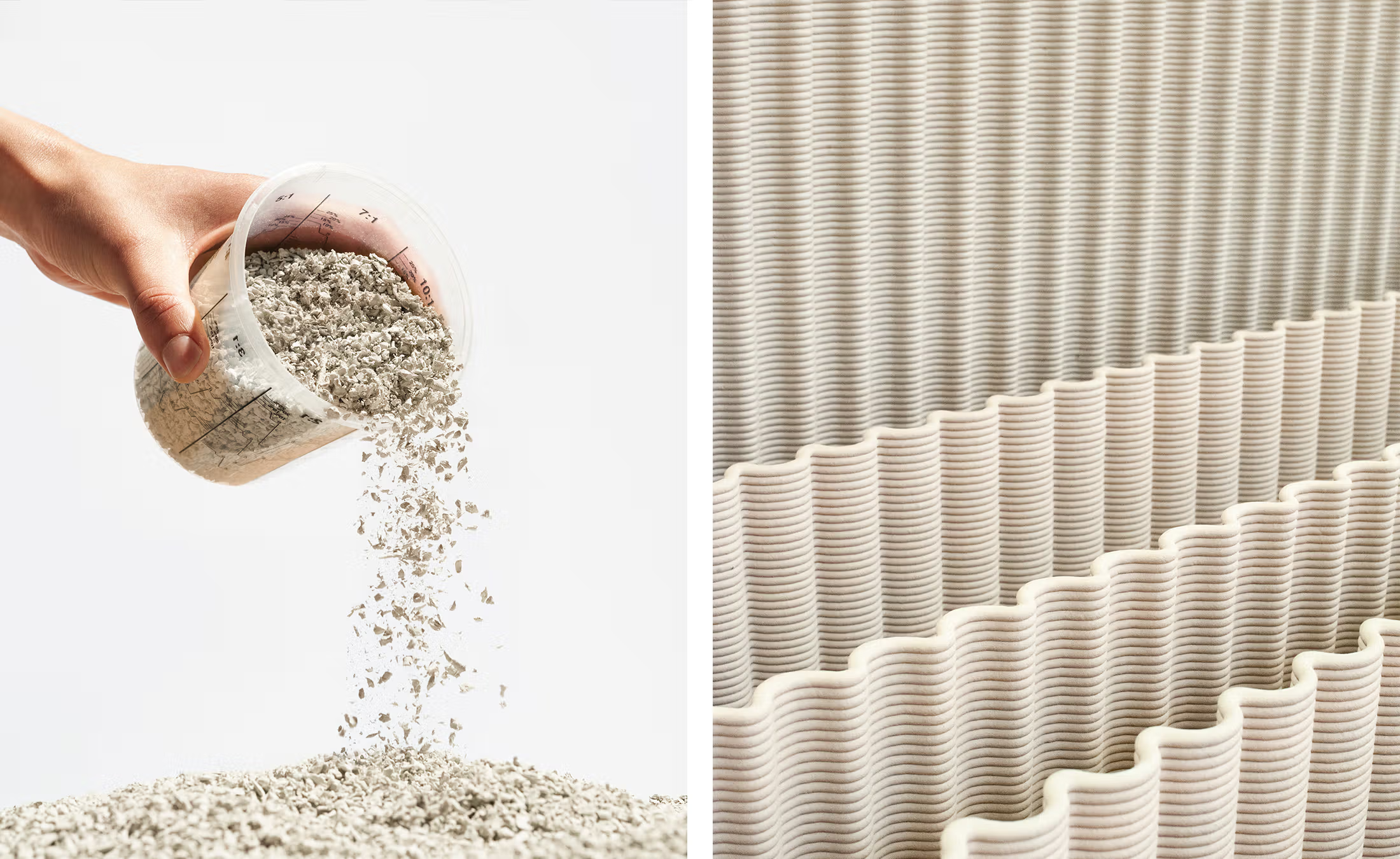
3D printing allows elements to be produced using only the material needed to form them, reducing many of the offcuts associated with subtractive manufacturing. Components can be made locally and on demand, while digital files can be adjusted without rebuilding an entire production system.
For retail, the most relevant applications may not always be complete façades or spectacular architectural gestures.
They may be smaller and more repeatable:
Product supports.
Signage components.
Handles and connectors.
Lighting elements.
Replacement parts.
Details that can be updated without replacing the system around them.
When recycled PLA or other recovered polymers are introduced into this process, the component becomes more than a customised object. It becomes part of a potentially repeatable material loop: produced, used, collected and transformed again.
The design is no longer frozen in its first form.
It can evolve with the brand.
Honest finishes last longer
Sustainability is not only about where materials come from. It is also about how long we are willing to live with them.
Retail has developed a difficult relationship with ageing. Surfaces are often expected to remain visually untouched, and the first scratch or variation is treated as a defect.
That expectation creates layers.
Coatings to protect coatings. Laminates pretending to be timber. Films pretending to be metal. Decorative surfaces applied to substrates that are then applied to other substrates.
An honest finish works differently. It acknowledges how it will age. It allows wear to become patina rather than damage. It uses fewer layers and avoids pretending to be something else.
Reclaimed timber does not need to look freshly manufactured.
Recycled aluminium does not need to disguise itself as chrome.
Cellulose panels do not need a plastic film to prove they belong in a premium environment.
Durability is not the ability to remain perfectly new.
It is the ability to remain valuable as time becomes visible.
Comfort is a material performance
There is another part of sustainable material design that is often overlooked because it is harder to express in a photograph.
Comfort.
A sustainable store should not only reduce environmental impact. It should also reduce the physical and cognitive effort required to occupy it.
Technical textiles manufactured with recycled fibres can improve acoustic absorption while creating softer spatial boundaries.
Textile ceiling elements can conceal infrastructure and reduce reverberation without requiring heavy suspended systems.
Carefully selected finishes can reduce glare, visual noise and the sense that every surface is competing for attention.
These decisions affect how long someone wants to stay, how clearly they can hear a conversation and how calmly they move through the space.
Using less material is valuable but using material to create a better experience is equally valuable.
Otherwise, sustainability risks becoming another technical score that performs well in a spreadsheet but is invisible to the person standing inside the building.
A responsible space should also be a comfortable one.
From material palette to material ecosystem
The next step is to stop treating the material palette as a collection of samples. A material board usually tells us how a store will look. A material ecosystem should tell us how it will live.
Where did each component come from?
What proportion is recycled or renewable?
How is it attached?
Which part will wear first?
Can that part be replaced independently?
Can the material be identified five years from now?
Can it be used again somewhere else?
Who takes responsibility for it when the store no longer needs it?
The emerging logic of life-cycle assessment, traceability and digital product passports will make these questions increasingly visible. But brands do not need to wait for every requirement to become mandatory before beginning to answer them.
Retail networks already have the scale to behave differently.
They can standardise recoverable connections. Create inventories of reusable components. Track where materials are installed. Design refurbishment into procurement contracts. Give local teams systems that can adapt without being discarded.
A store can become a temporary arrangement of materials rather than their final destination.
The takeaway
The sustainable store of the future will not be defined by one miracle material. It will be built from a series of better decisions.
- Materials with a previous life that still create a strong first impression.
- Lighter systems that achieve more with less.
- Components designed to be repaired before they are replaced.
- Finishes that age without losing their value.
- Surfaces that improve comfort as well as environmental performance.
- Assemblies designed around the possibility that everything may need to change.
Because sustainability is not a visual style. It is not a layer applied at the end of the project. And it is not a collection of plants placed beside conventional materials.
It is a way of deciding what enters a space, how long it stays and where it goes next.
The most sustainable store is not simply the one built with better materials. It is the one that never treats those materials as disposable.



Vamos a crecer ¡juntos!
¿Tiene preguntas sobre su próximo gran paso?
Mormedi tiene respuestas.