.svg)
This was my first time at Aircraft Interiors Expo. I have spent the last few years working across aviation from a commercial and strategic design perspective, but I had never walked the show floor in Hamburg. I should have come sooner. The concentration of talent, engineering depth, and genuine ambition to make flying better was something I was not expecting at this level. Three days, over 500 exhibitors, the Crystal Cabin Awards, the Passenger Experience Conference running in parallel, and conversations with some of the sharpest people I have met in any industry.
I left Hamburg with a feeling that has not faded. And it is a simple one: the airline industry has an enormous opportunity to do dramatically more for the passenger experience, and it does not require a revolution. It requires intention.
Here are some of the things I left with...
The Weight Revolution
If you had to pick one number to summarize AIX 2026, it might be six. That is approximately how much an Expliseat TiSeat 2X economy seat weighs, thanks to a titanium and carbon fiber composite structure that is redefining what seat engineering looks like. A conventional economy seat weighs between 10 and 14 kg. Expliseat has effectively cut that in half.
The implications go well beyond engineering bragging rights. Weight is the single most expensive variable in aviation. Every kilogram saved means less fuel, lower emissions, and real money back in the airline's pocket. Across a full aircraft, pairing Expliseat's economy and business class products can save up to 600 kg on a regional jet and over twice that on a single-aisle. That is not optimization. That is a different operating model.
But here is the part that really got me thinking. That saved weight creates room. Room in the budget, room in the cabin weight allowance, room to reinvest in the parts of the experience that passengers actually feel. Better catering. Better amenities. Better connectivity. The seat becomes a platform that enables everything around it to get better. At AIX, Expliseat also debuted the TiSeat S, their first business class product for regional jets, offering 40% weight savings and a shared component platform with their economy range. They signed their first US airline customers at the show, breaking into a market historically dominated by three legacy suppliers. Their backlog now exceeds 200 aircraft.
Materials science is quietly becoming one of the most powerful levers for passenger experience. That is a sentence I did not expect to write, but Hamburg made it obvious.
Economy is going premium
One of the clearest signals at AIX 2026 was that economy class is no longer an afterthought. Airlines and suppliers are starting to design it like it matters, because it does.
Collins Aerospace won the Crystal Cabin Award for Passenger Comfort with SkyNook, and it generated more conversation on the show floor than almost anything else. The concept addresses a problem that exists on roughly 3,000 widebody aircraft worldwide. In the aft section of economy, where the fuselage tapers inward, airlines typically reduce the standard triple seat row to a double. That leaves an unused gap between the outboard seat and the cabin wall. Wasted space on every single flight.
Collins designed a deployable armrest console that slides out from the side of the outboard seat to create a secure, usable surface. It can hold a baby bassinet with proper belt mountings, accommodate a child car seat throughout all phases of flight, or simply function as extra workspace. There is also an optional sliding door on the aisle side that creates a semi-private enclosure, offering some sound insulation from the nearby galley and lavatories. The product targets families with young children, passengers with sensory sensitivities, and travelers with assistance animals. Collins estimates airlines can recoup installation costs in about one year. SkyNook will begin its market introduction later this year on Boeing 787 aircraft.
What makes SkyNook exceptional is the thinking behind it. Collins did not redesign the cabin. They looked at space that already existed and asked a better question about what it could become. In an industry where certification timelines and structural constraints make radical change very difficult, this kind of intervention is where the highest-ROI innovation lives.
They presented Spaceframe, a modular economy seat concept combining lightweight design, ergonomic mesh backrest, wireless charging, and fully recyclable materials. Recaro Aircraft Seating won the Crystal Cabin Award for Sustainable Cabin with the R Sphere concept seat, saving approximately 1.5 kg per passenger using sugar cane-based composites and reducing CO2 emissions by around 55 metric tons per single-aisle aircraft annually.
Economy is being elevated, not through gimmicks, but through smarter materials, better use of space, and a recognition that the back of the cabin deserves the same level of design thinking as the front.


Business Class Is Becoming First Class
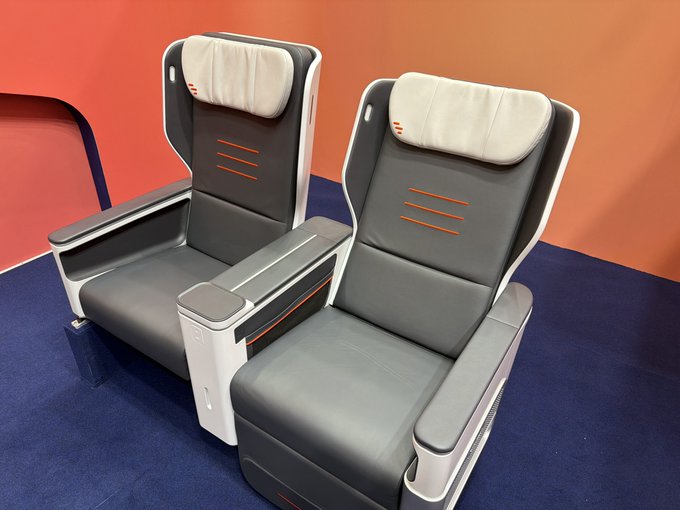
One of the most interesting trends at AIX was the blurring of the line between business class and first class. Several manufacturers are now designing products that allow airlines to offer a first-class-caliber experience within the business class cabin, without dedicating an entire section (and the associated real estate) to a traditional first class.
Thompson Aero Seating debuted VantageXL+ First, which takes their existing widebody business class seat and adds an enhanced front row that enables group socializing and dining for two or four passengers in a "Star" configuration. The idea is to create a premium, first-class-style experience in the first row of business without reducing seat density. Delta was announced as the launch customer for the VantageNOVA platform. And Hainan Airlines signed as the Chinese launch customer for Thompson's Vantage lie-flat on A321neos.
ANA won the Crystal Cabin Award for Cabin Concepts with THE Room FX, their new business class suite for the Boeing 787-9. Every one of the 48 seats has a privacy door. The alternating forward/aft-facing layout at 103-inch pitch creates a spatial experience that feels closer to what you would expect on a larger aircraft. ANA describes it as the largest seat in its class on a mid-sized plane.
Airbus showcased their Airspace First Class Experience for the A350-1000, with a 1-1-1 configuration where the center Master Suite includes a private lavatory, changing area, bar, and double bed.
Airlines are finding ways to sell a first-class experience without the first-class cost structure. The front rows of business class are becoming the new premium frontier, and the design sophistication required to pull this off, balancing density, comfort, flexibility, and brand identity, is exactly the kind of challenge that strategic design consultancies should be paying attention to.
The seatback as the third digital channel
The Passenger Experience Conference ran alongside AIX, and the sessions I attended added a strategic dimension that the show floor alone cannot provide.
Panasonic Avionics gave one of the most compelling presentations of the week. Their core argument: the connected seatback is now the third digital channel for airlines, alongside web and mobile. When a passenger profile follows them across all three touchpoints, each interaction becomes more valuable than the last. They call it "The Power of Continuity."
They framed the passenger value proposition around four principles. Seamless journey continuity, where preferences persist across channels. Relevant moments, where the right content arrives at the right time without anyone having to ask. Experiences that feel personal, not predictable. And being uniquely understood, so that needs are anticipated before friction even appears.
On the airline side, they mapped the commercial impact across customer experience, loyalty, operations, and revenue. Data-driven NPS improvement. Richer loyalty member understanding. Cost savings through operational efficiency. Higher lifetime value through targeted ancillary revenue.
They also raised what they called the Personalization Data Paradox. Airlines are swimming in data from digital interactions, real-time flight context, customer databases, partner ecosystems, cohort analysis, and in-flight feedback. The problem is not data scarcity. It is turning that flood into something actionable that changes how a passenger actually feels.
This is the work we do at Mormedi every day, across our industries. The technology is there. The data is there. What is often missing is the experience architecture: the strategic layer that connects inputs into a coherent, end-to-end journey that feels intentional rather than accidental.
United, Delta, and the connectivity race
United Airlines presented their onboard transformation at the conference, and their roadmap was ambitious but clear. Four pillars: IFE screens at every seat, a new platform with enhanced user experience, the best content library available, and super-fast connectivity from Starlink. Built in collaboration with Starlink, Axinom, and Spotify, their system treats the onboard digital experience as a fully integrated and monetizable engagement platform.
Delta is running a parallel play with their Connected Onboard Platform, which won the Crystal Cabin Award for IFEC & Digital Services. They have unified operational, connectivity, and passenger experience data across their entire fleet of over 1,000 aircraft, regardless of IFE or IFC provider. The results: 25% fewer IFE defects, higher cabin reliability, measurable cost savings. The same architecture powers Delta Sync, delivering personalized content and proactive service recovery from real-time data.
Both airlines are making the same bet: that onboard connectivity is not an amenity. It is infrastructure. And the airlines that build the smartest platforms around it will have a structural advantage in loyalty, ancillary revenue, and passenger satisfaction.
The details that add up
Beyond the headline products, AIX was full of smaller innovations that collectively paint a picture of an industry raising its game across every dimension.
Diehl Aviation won the Crystal Cabin Award for Accessibility with AURS, a system that makes aircraft lavatories navigable for blind and deaf passengers through tactile guidance, Braille, adaptive lighting, and personalised settings activated via Bluetooth beacon. It is fully certifiable and ready for deployment.
AviusULD won Cabin Technologies with SmartULD Fire Tag, which detects gas compounds that precede lithium-ion battery fires up to two hours before they occur. The tags can be installed in overhead bins and cargo containers. Given the growing concern around device-related fires, this could become an industry standard quickly.
Recaro Aircraft Seating won the Sustainable Cabin category with the R Sphere concept seat, saving approximately 1.5 kg per passenger using sugar cane-based composites and recyclable materials, reducing CO2 by around 55 metric tons per single-aisle aircraft per year.
Takeaway
As I was mentioning before, I left Hamburg with the feeling that the airline industry is sitting on an enormous opportunity to do dramatically more for the passenger experience, and the barriers are lower than most people assume.
An economy seat that weighs 6 kg. Dead space transformed into the most desirable seat in the cabin. A business class front row that delivers a first-class experience without the first-class footprint. A seatback screen that becomes a personalized engagement channel. An accessible lavatory that adapts to the user. A fire detection tag that predicts danger before it happens. None of this is 2035 thinking. This is entering service now.
What struck me most was the talent. The engineers, designers, strategists, and entrepreneurs I met in Hamburg are people who care deeply about making air travel better. The quality of thinking is world-class. And the appetite for cross-industry collaboration, pulling from automotive, hospitality, digital platforms, and materials science, is stronger than I have ever seen.
The common thread across everything I saw is that the biggest improvements do not always require the biggest investments. They require a different kind of thinking. One that starts with the experience, works backward to the technology, and ensures that every element, physical and digital, works as part of a coherent system. The experience is not a single touchpoint. It is the entire journey. And the airlines and partners that understand this will be the ones that win.
That is the work we do at Mormedi. Whether the challenge is in aviation, mobility, banking, or retail, the question is always the same: what should this experience feel like from end to end, and how do we design every touchpoint to deliver on that promise? Hamburg confirmed that the tools, the materials, the data, and the connectivity are all there. The industry is ready. The challenge, as always, is connecting the dots.
And I, for one, cannot wait to go back next year.

Let’s grow together!
Have questions about your next growth move?
Mormedi has answers.